Like 100 million other people, I saw the Kony 2012 video over the past few days. It’s now considered the most viral video in history, per Mashable.
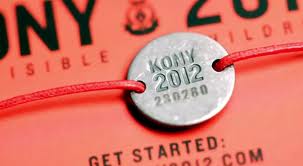
The merits of the Invisible Children video are clear, but the criticisms have been a little muddier. The ones I heard from established media outlets late last week were not outright nasty, but had an air of “Oh, really?” to them.
The need to sniff out what could be too-good-to-be-true (the 30 minute video is rather slick) puts journalists on other side of the story in a way that must be discomfiting. They have held IC’s founder Jason Russell to the same scrutiny, if not more, as they did Julian Assange. For Assange, a man who hides his judgment and tries to out objectify the news media, the message is that information will be liberated. For Russell, the message is that information will be used to accomplish specific goals. He is saying “I can shine a light on stories and injustices that are old news to you.”
The Times’ criticism turned out to be a common charge against the filmmaker:
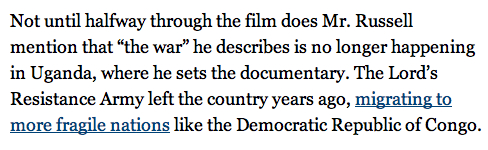
OK, but where does Russell set it up as a war to be stopped? It’s clear in the film that his goal is justice for what has occurred. Preventing attacks on civilians, conscription of children, and the sexual slavery of young women are acknowledged benefits of stopping Kony now, but the Times needs to point out that there is no war going on so why bother rubbernecking?
Last Friday, NPR’s Morning Edition engaged in a classic tactical maneuver when addressing the film: take the highest ground. They enlisted the head of the U.S. Africa Command (AFRICOM) to give an interview qualifying American interests on the continent. There was a smooth allusion to the 100 advisors sent to Uganda by the President to pursue Kony – but no mention of him by name.
They did mention him immediately afterward in the next piece, an interview of a Ugandan journalist. The echo chamber was deafening. The journalist made the point that the the Kony 2012 film wasn’t for a Ugandan audience. It wasn’t for people who knew the score. She then brought out the two tropes getting so much traction as criticisms of Invisible Children’s message: that the civil war is over and that Kony isn’t in Uganda. These are fine points for a journalist to make (game over; losing team left), but showed no insight into what the group was actually trying to accomplish.
The high ground had some other visitors in the form a blogger for Foreign Policy who has a more-of-the-same background on the region and narrow understanding of cause marketing and fund raising:

Money and awareness are probably what those well-meaning people can provide. But why would you need those when you have a nuanced understanding of the issue at hand? Let’s paraphrase for effect: “It would be great to get rid of cancer. It has left a wide path of destruction in our community for the past 20 years. But the type that people get now isn’t metastasizing and the tumors are very small. While it is still causing immense suffering, it’s unclear how emotional and financial support could help alleviate it.”
So this is the left flank of journalism in 2012. Fending off the aggregation monsters of Drudge, Huff and Buzzfeed has been best accomplished with the in-depth investigative journalism that commands attention for several days (or hours, if they’re lucky). This time the scoop was on an old story, a cold case. At 7 minutes and 30 seconds into the video you can see that Jason Russell makes promise to keep to his friend Jacob. He has a grudge. He doesn’t have a late night deadline to beat and an editor to impress. It’s a question of who can tell the most powerful story and he won. You can hear the reporters saying, “If we didn’t think it was a story now why is it a story now?” In fact, you can actually hear them say it in this Daily Show clip that made me think it was worth writing this post.
Not all hope is lost though. The Guardian gathers every angle together and talks to the only person we are made to truly care about in the film: Jacob Acaye.




 The True Gen