Categories
Business Entrepreneurship Lean Startup Process

How “Revolutionaries and Evolutionaries” can use innovation tools to build sustainability

Seth Barrett is the kind of frontline leader that Lean Startup was made for. He’s been a VP at a DC-based startup, a product manager at Bloomberg, and was even a producer at AOL back in its heyday. He’s been on the small teams tasked with innovation and he’s been on the established product side of organizations that want to see sustained and steady growth.
rev-evol

“I’ve seen the tension at most of the companies where I’ve worked,” says Barrett, currently a consultant for a Fortune 500 insurer working on new digital products. “When you get aggressive and want to innovate, there’s always a risk for cannibalization from a commercialization standpoint, especially if the business is successful.”

The other management peril that Barrett has seen is when small teams are sequestered off on their own or a new department is spun off and tasked with innovating in a way that directly challenges the way the legacy organization has been running the business. Simply put, the idea of an internal startup doesn’t ring true for him. “The guys doing the revolutionary work aren’t tethered to reality. They are cooking up concepts that could be great, and they may address customer needs, but they may break down under the full weight of solving the customer’s problem.”

That tension has given him a new perspective on the methods of innovation, specifically Lean Startup, that he didn’t learn in business school.

“Lean Startup is a critical component of sustainability,” says Barrett. “People look at innovation as a threat to sustainability but in the long run it’s the opposite. A company that has been growing at 5 percent a year and doesn’t want to see a down fiscal year based on an innovative new product rollout still needs to find way to bring new ideas to market without upending their apple cart. Their long-term survival depends on it,” Barrett says.

Entrepreneurship is Not Just for Entrepreneurs

Providing the “evolutionaries” who are working on the frontlines of the established business with the tools of the “revolutionaries” who know how to cut new paths forward with innovative ideas and products resonates with Barrett.

“How Lean Startup plays into it for me is that you can run controlled experimentation in parts of the company and then the most useful and sustainable ideas that actually work will get more institutionalized into the core business. It’s that validated learning that gets all stakeholders on board with an idea because it’s been made real.”

In his own consulting work, Barrett often references the work of The New York Times to help make the connection for his clients and to illustrate Eric Ries’ principle that entrepreneurs are everywhere.

“Yes, they are this eminent and established publisher but think of how much product development they are able to test on a real audience. They can experiment with products in a different way than a service or product company. They can even solicit user-generated content and then they can embed it into their general offering.”

Break the Model or Bend It?

On the frontlines, Barrett recognizes that evolutionaries know how the product is used, they understand the customer, and they know the operational challenges that their teams face. Whereas the revolutionaries just see a model that they want to break.

“You have to be able to do both,” he says. “If you don’t do the revolutionary, someone will replace you. But really you have to do both in one aligned direction. You need to merge the innovation function into the operationalization of the legacy product.”

The two parties need a common language and that’s where a framework such as Lean Startup comes in, from Barrett’s perspective. “Both functions are important. They are mutually informing. They need to connect and iterate together. Without that shared learning from all parts of the organization there may be continued growth but it’s going to decelerate eventually.”


Categories
Business Food Process

There’s no success like failure

My pop sent me a link of an interview with David Chang on The Paul Holdengräber Show. It’s worth watching if you’ve been to Momofuku, want to go (me), and/or you are interested in failure (everyone). Talking about life in general, Chang said, “Everything boils back down to risk.”

As a chef and as entrepreneur, Chang is accustomed to risk. Maybe more than most. He started with a “ridiculously small” noodle bar in the Lower East Side eight years ago, and now he is a cooking icon. It’s no big thing. As he says, “Who cares if you end in failure?”

Risk, failure and food have been on my mind after reading The Lean Startup by Eric Ries. The idea of taking a chance on what Ries calls a minimally viable product (MVP) is pretty well known in the food industry. You have got to get something on the plate, and there’s no need to fuss about how that gets done. In the same way, Ries advocates getting a product in front of customers fast and then seeing how they interact with it to help your execution improve. The opposite of this would be working out every bug and glitch in stealth mode until it was time to spring your device/site/service on the whole world. But what if they don’t like it?

One of Ries’ great examples is a startup that offers a web-based recipe search that can take the dinnertime hankerings you have and turn them into a complete, budgeted shopping list. One of the risks for this startup was that when they began the rollout to potential customers, they weren’t actually using their product. Instead of introducing a site that could handle a customer’s requests and spit out a list, they found one person who was open to the idea and went to her house and wrote down what foods she wanted to feed her family that week. Then they would consult chefs they had already lined up and determine what the ideal recipes and shopping list would be based on time-to-cook, cost, health and variety. They also made sure that all of the ingredients included in the recipes were at her go-to grocery store. And then they would collect a check from her for $9.95 a week! This doesn’t sound like a company that Google would swoop in and offer billions for in a few months.

The business partners were learning a lot though. Once they had perfected the system with one customer, they added another. Once they arrived at more than they could handle logistically, they started using their site and email to capture the information and deliver to the customer as promised.

The company, Food on the Table, started in Austin and is now in cities across the country. When you look at what they did, the beauty is in that there wasn’t much upfront risk. Or if there was, it was matched step-by-step by the amount of insight they were gaining. They flattened out expectations and gradually ramped them up based on what reality told them and what their missteps revealed – not on what they heard in a breathless meeting in a windowless room.

It sounds like that same experimental approach that has led Chang to his current level. As he says, “Let’s make some really big mistakes. They are exciting to me. Even bad mistakes. They’re not fun to deal with, but you learn. That’s life.”

Categories
#SM Process Work Writing

The effect of Christmas and midterms on blogging productivity (a pie chart)

We like to think we know how to get things done here at The True Gen. Not true this December, as evidenced by the neither positive or negative number of blog posts so far this month (a roundabout way of saying zero).

I think the next editorial meeting may feature a slide with this graph on it:

Courtesy @DemetriMartin.

Categories
Business Process Writing

Brainstorming: There are rules, people!

I cribbed this from multiple mentors, mostly Lynn Whittemore, a graphic design exec. who was equal parts creative and effective. The format came from a page on the George Mason Center for Leadership and Community Engagement website that is now gone, but the content needs to be preserved and used.

Rules for brainstorming

  • No criticism, evaluation, judgment, or defense of ideas during the brainstorming session.
  • No limit on “wild” ideas, no matter how outrageous or impractical they seem. Every idea is to be expressed.
  • Quantity is more desirable than quality.
  • “Piggybacking” (building on ideas—is encouraged).
  • Everyone must be encouraged to participate.

Steps to finalizing ideas

  1. Record all ideas.
  2. Choose “top 5 ideas”—combine similar ideas when appropriate.
  3. Individually rank ideas.
  4. Decide, as a group, which idea will be enacted first.
  5. Begin the brainstorming process again as necessary.
Categories
Process Uncategorized

Flow: A chart

I’m a big fan of Mihály Csíkszentmihályi’s book, Flow. (Wikipedia tells me the name is pronounced mee-hy cheek-sent-mə-hy-ee.) Simplistically, it’s a psych book for people who already like life and want to get more out of it.

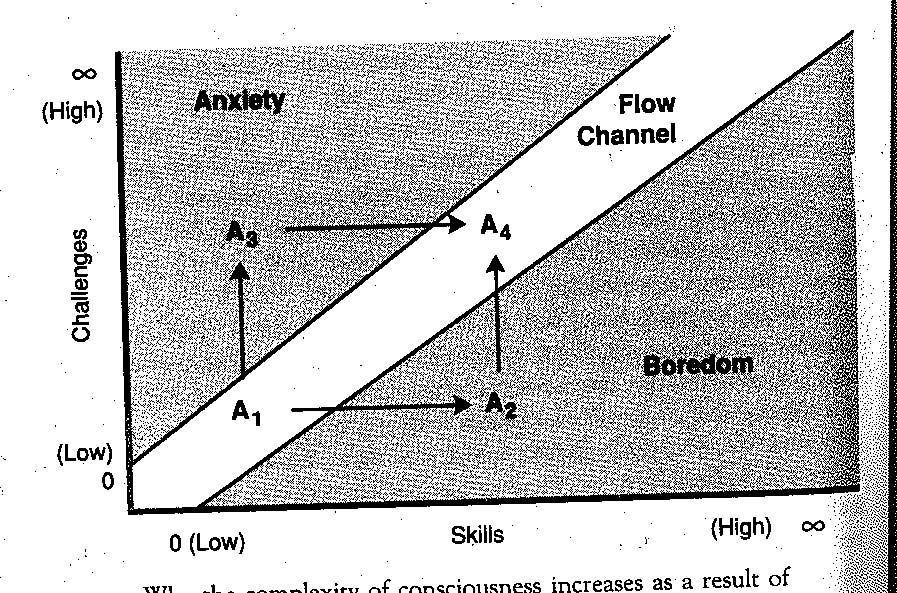
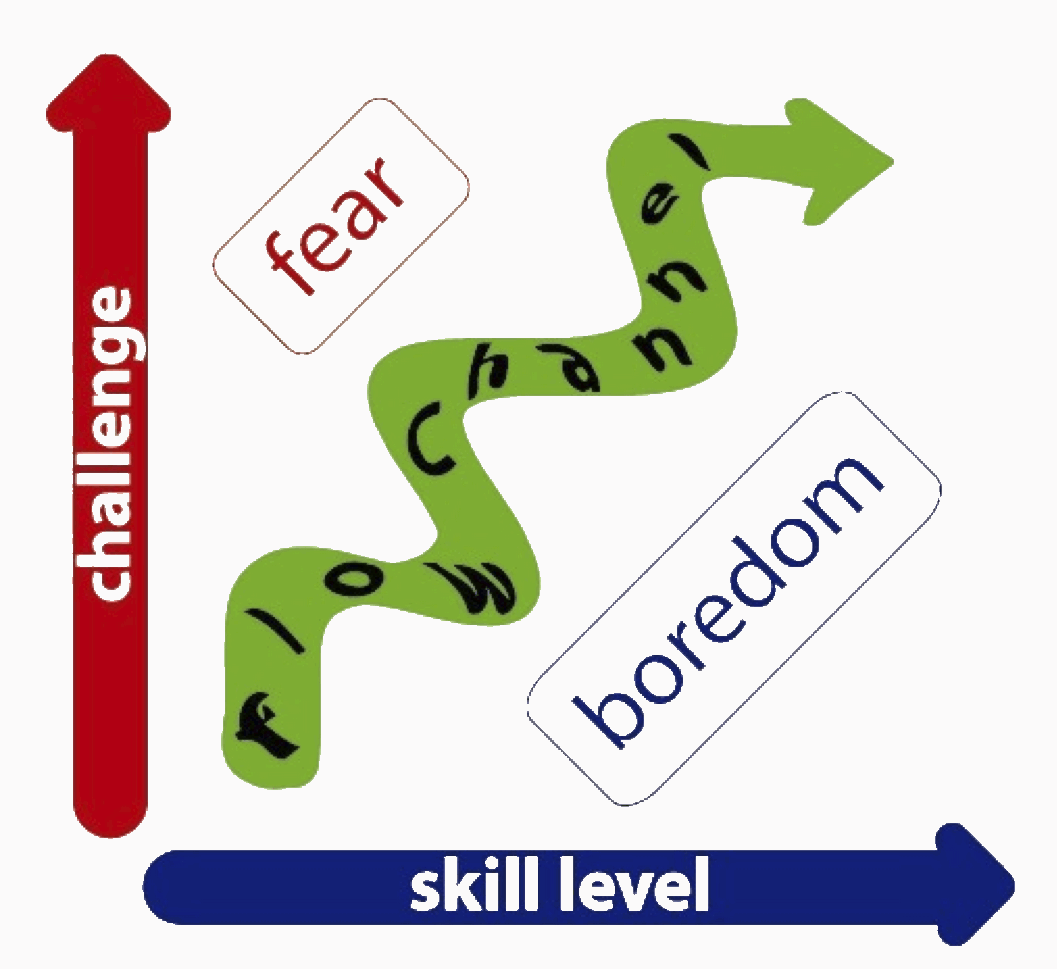
The idea is that to really get locked in to the task at hand, your skills need to be challenged at just the right level. Too much challenge and anxiety sets in. On the other side, if your skills are untested, you get bored.

Here is how M.C. represents it in the book:

For comprehension’s sake (my own), I simplified it a bit here:

Each time you get bored with what you’re doing, be it work, your golf game, the ski run you’re on, or what you’re reading, find a way to make it interesting again with a new challenge. Then, when you find yourself on the edge, figure out which skills or what kind of preparation can bring you back to the center.

Categories
Process Uncategorized Writing

A new blogger’s two best friends: the drafts folder and a content calendar

Oh, boy: a blog post about blogging. We knew this day would come but not in the sixth post…

The good news is I will be brief and (ideally) helpful. Getting a blog going has been fun, but the actual work involved, the brain space required, and the teeth gnashing over grammatical mistakes has been a surprise (please post a comment when you find them, Dad).

To help keep things going I have two ideas on how to make the process a bit smoother:

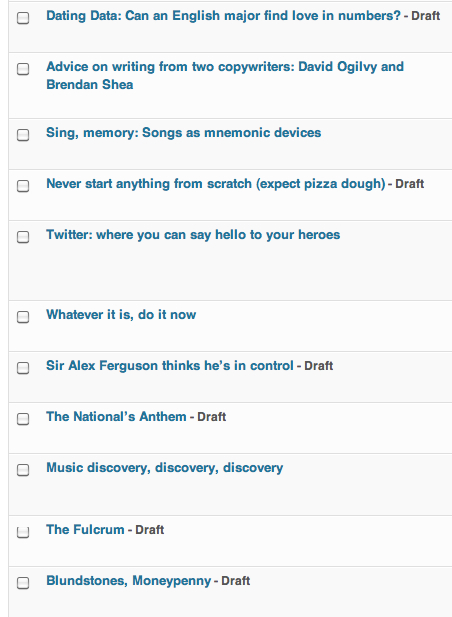
1. Fill your drafts folder with post ideas

Fight bloggers’ block by noting potential blog topics in your drafts folder. Throw in a headline and at least a few lines of body copy. When bloggers’ block strikes, hit the preview button for a particular topic, and you’ll see what it could look like published for all to see. It will be a little more motivating than something scrawled on a yellow sticky or floating next to your grocery list in an Evernote app.

2. Get thee a content calendar

This covers some of the same ground in terms of capturing your ideas for posts, but gives you more of an overview of the content you want to create in down the road. I created one that goes through December 2012 in Google Docs that you can download as an Excel file. It’s very basic – take a peek:


A lot of the work in health content I do revolves around the National Health Observances. This can serve as your personal version of that: a collection of your own observances and rites that you want to share. A must have for all the Wiccan bloggers out there.

I’m new to this, so maybe these ideas aren’t new to you. Either way, please post any tips you’ve developed for putting the “ing” in blogging.

Categories
Business Process Writing

Advice on writing from two copywriters: David Ogilvy and Brendan Shea

At the intersection of art and commerce is David Ogilvy, directing traffic, crafting copy, and turning phrases. In a bit of blasphemy for a wannabe marketer, I know very little about the man, other than he was/is known as the Steven P. Jobs of his industry, rewriting the rules of advertising as he went.

Copywriting was tip of Ogilvy’s spear – the fine point backed up by research and analysis that made a few words move a few million (dollars, units, people, what-have-you). I’ve made a living as an editor and writer, but I’ve never written copy, and who knows if I could have. Writing news stories and editing health content are broad brush strokes compared to the tatoo-ink precision required of penning ad copy.

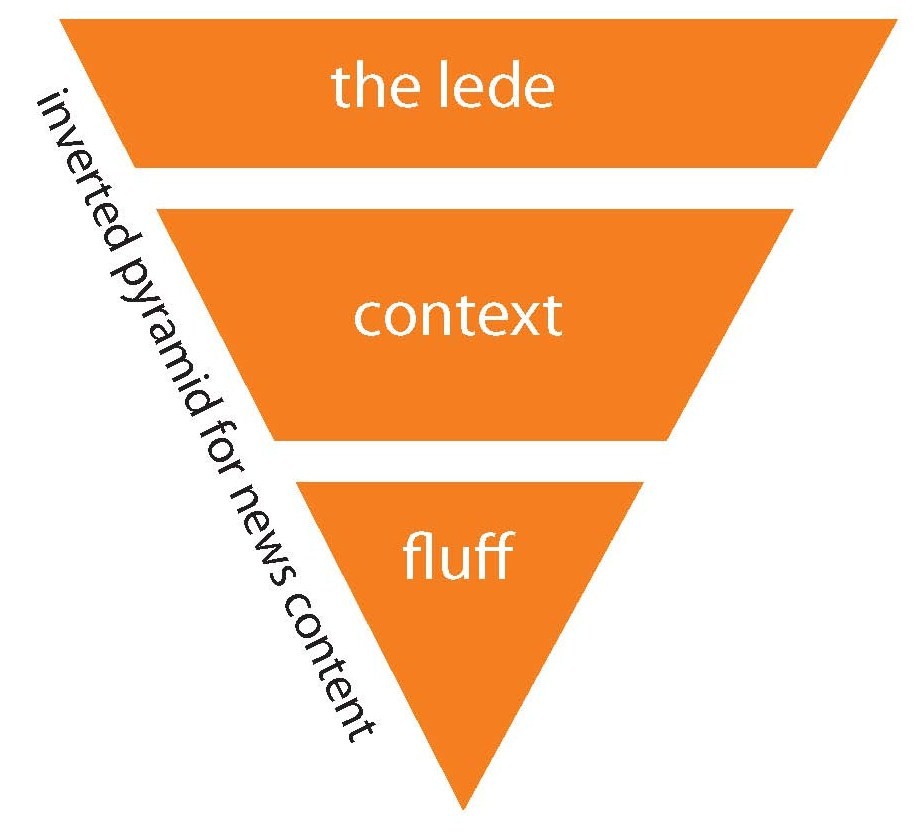
In journalism, the hoary format of the inverted pyramid applies even through the digitization of news: fill the top with the important stuff (the lede), and gradually taper down into the fluff. The fluff reads like a straight transcript of a reporter’s notes with no sense of an actual story being conveyed. It’s the journalistic equivalent of running out the clock. In contrast, an ad is read in a few ticks of the second hand.


In a quote collected for Good Advice on Writing, Ogilvy advocates for writers to:

“Avoid superlatives, generalizations, and platitudes. Be specific and factual. Be enthusiastic, friendly and memorable. Don’t be a bore. Tell the truth, but make the truth fascinating.”

I asked Brendan Shea, current Senior Copywriter at Loyola University Chicago and former copyeditor at Leo Burnett, if he agreed.

“It’s the classic point of view, but I have a slightly different philosophy,” said Brendan. As a fan of Ogilvy, Brendan can rattle off D.O.’s book titles and quote his maxims, but sees differences in how copywriters approach their words now. “Ogilvy also said, ‘the more you tell, the more you sell,’ but I don’t think that always applies today. The ads need to resonate fast.”

Brendan’s ads extolling the virtues of a Jesuit education are resonating all over the city on CTA properties — even wrapping a whole train for the “Enter One Way, Leave Another” campaign for Loyola. Brendan details a specific copywriting philosophy, and, with some advice for wannabe copywriters, he said, “Have a thick skin. You are going to write something that will be out there so you need to own it. You’ll do great stuff, and you’ll do terrible stuff. Either way, it’s going to produce a visceral reaction.”

He has personal proof of that reaction — one of his campaigns came up for discussion in one of his graduate school classes, and the feedback from at least one classmate was not positive. When his boss heard this, she told him he should have defended the piece, but Brendan wasn’t fazed. “I actually liked hearing what was said. It helps. You have to stop caring. Just listen and learn from people.”

Categories
Process

Whatever it is, do it now

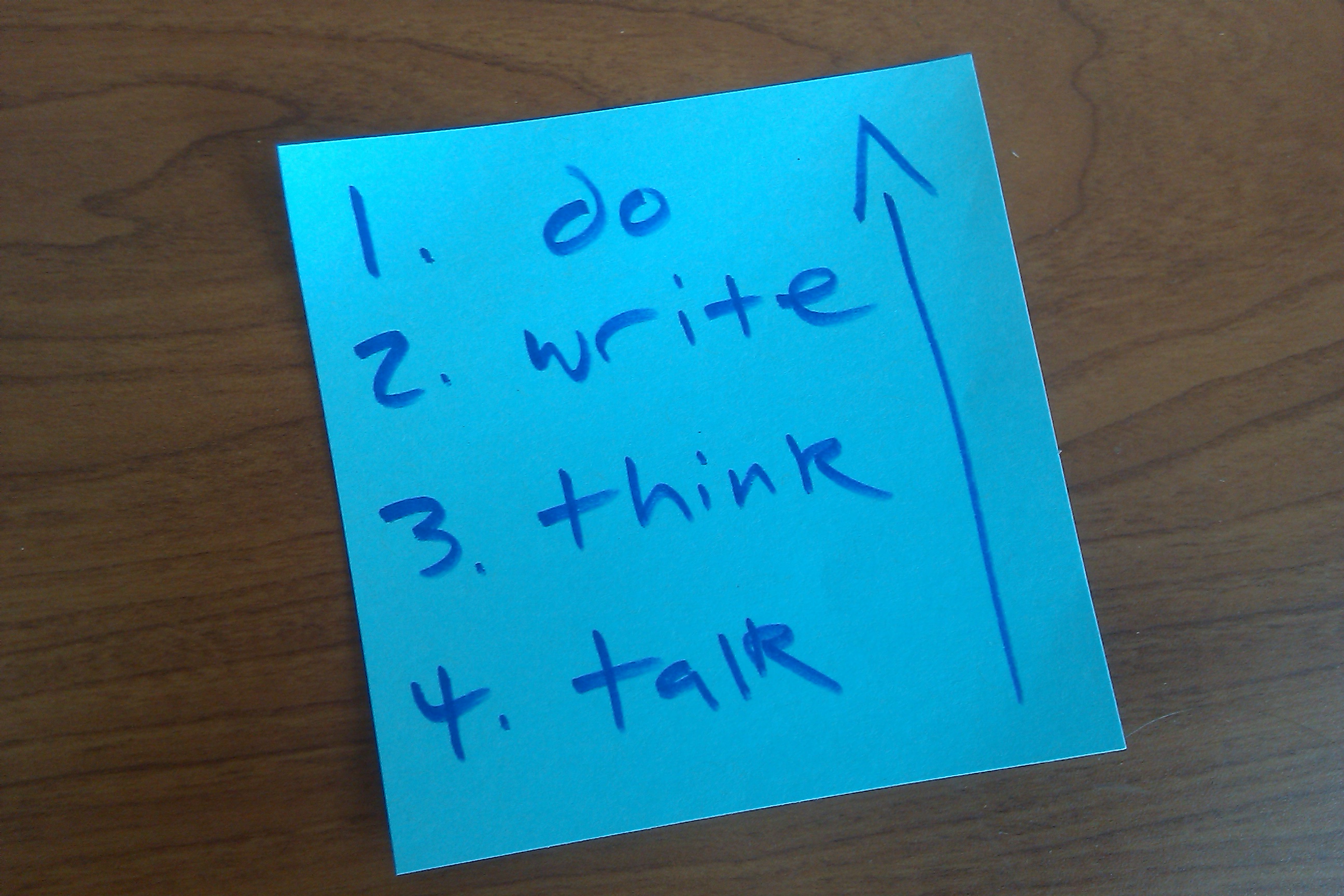
If you can’t (1) do it now, you can (2) write about it, (3) think about it, or (4) talk about it. In that order of preference.

I find this helpful for keeping an idea moving. Everyone does—who doesn’t jot down the inspired idea from a long drive or a good run? The finer point of these four stages is that you need to designate time for each one in order to get you further up the chain. The key one is number 2 — writing about an idea is like thinking it over with consequences, readying for the actual execution and the self-flagellation that comes with reviewing your own crap copy.

This little hierarchy comes with some inspiration provided by Kaihan Krippendorff, a Fast Company blogger who breaks down his ideas into the following categories:

1. Wastes of time
2. Tactics
3. Winning moves
4. Crazy ideas 

There’s more here if you want to dive in. It doesn’t matter which idea goes into which category. At some point you know you need to do it (now).