Editor’s note: This is a letter from my father to his four brothers and two sisters about their family history going back as far as able. If you’re reading it on a phone or tablet, switch to landscape orientation.
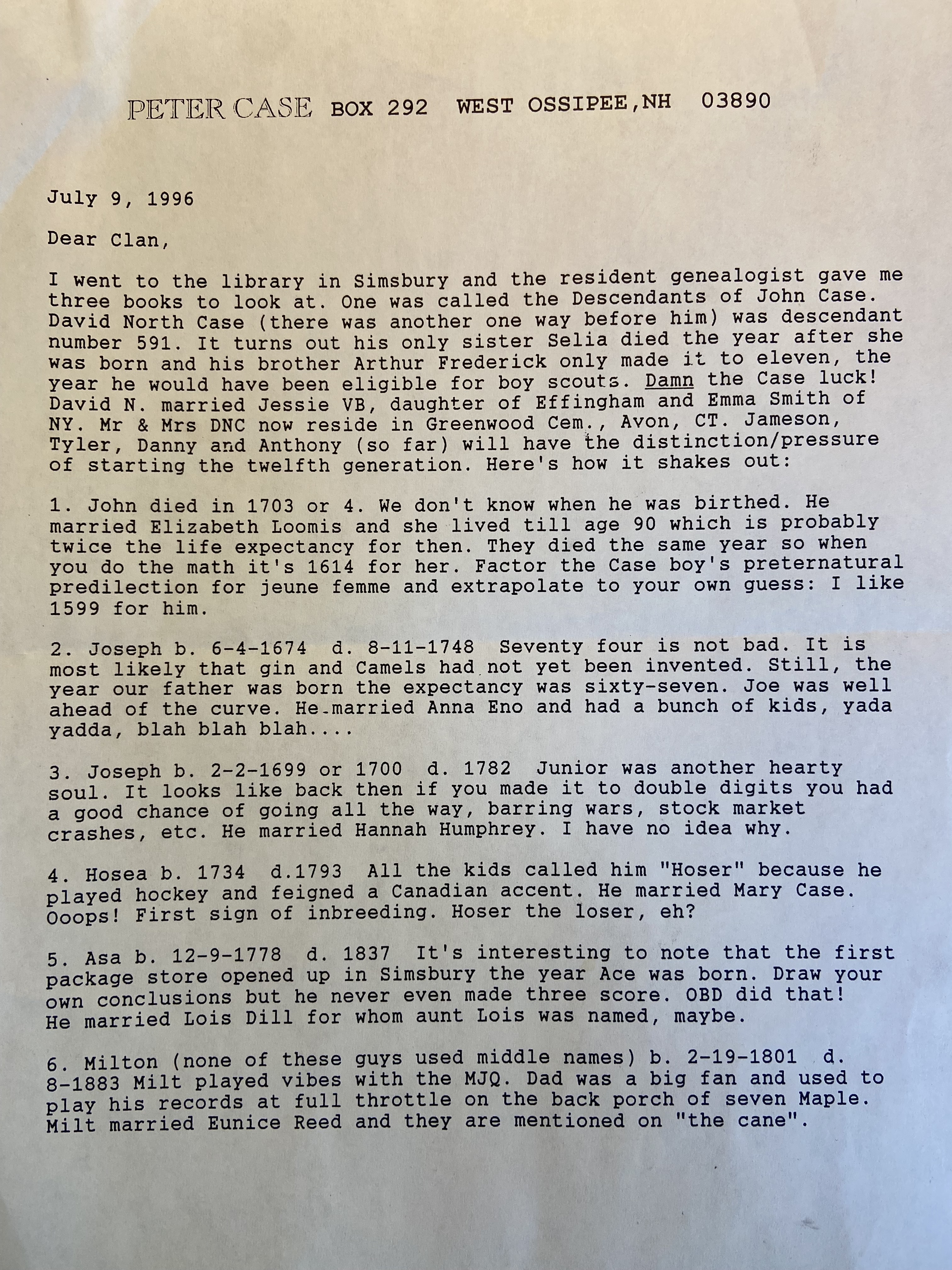
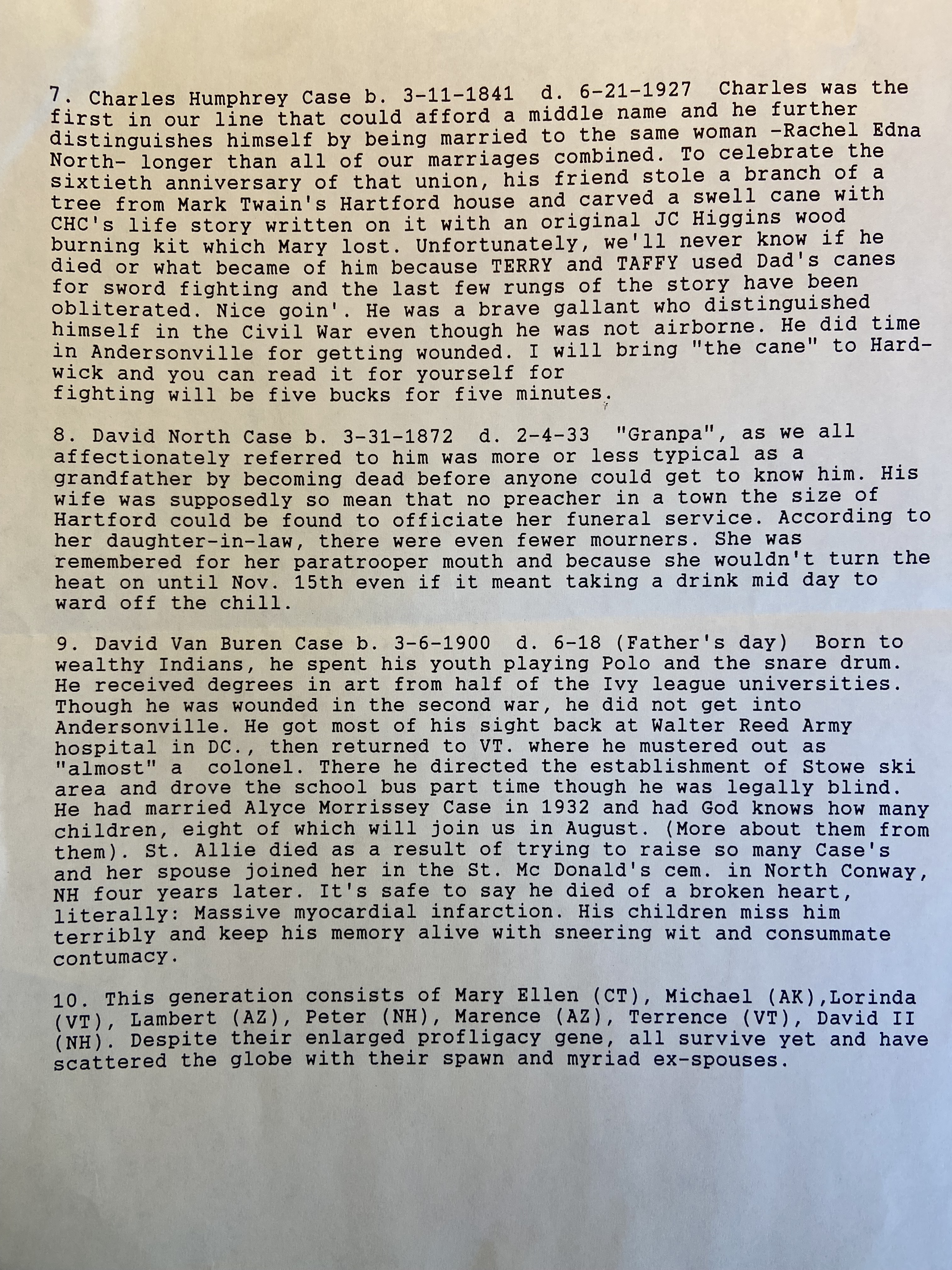
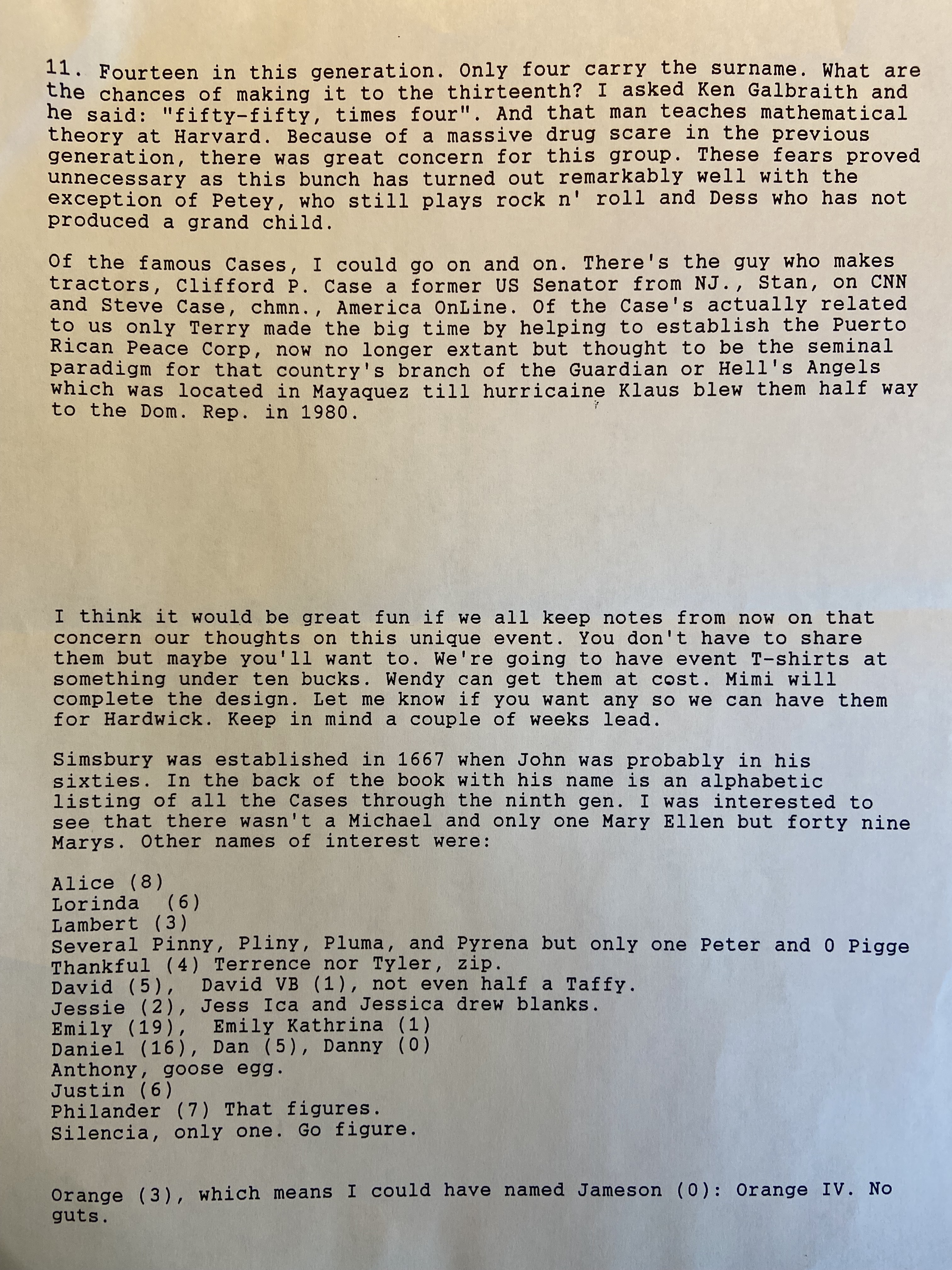

Editor’s note: This is a letter from my father to his four brothers and two sisters about their family history going back as far as able. If you’re reading it on a phone or tablet, switch to landscape orientation.
This blog hasn’t always been worth reading but it’s been worth keeping. I started it 10 years ago as a way to learn WordPress and help a family friend start an actual blog.
It’s now morphing into a repository for family history, housing a fun letter from my dad to his siblings that I’m calling Dear Clan and a 10,000 word autobiography written by my uncle titled An Exceptional Memory: The Autobiography of Mike Case.
Enjoy any and all pieces and if you spot any typos, errors or omissions, let me know at jameson.case@gmail.com.
Seth Barrett is the kind of frontline leader that Lean Startup was made for. He’s been a VP at a DC-based startup, a product manager at Bloomberg, and was even a producer at AOL back in its heyday. He’s been on the small teams tasked with innovation and he’s been on the established product side of organizations that want to see sustained and steady growth.
“I’ve seen the tension at most of the companies where I’ve worked,” says Barrett, currently a consultant for a Fortune 500 insurer working on new digital products. “When you get aggressive and want to innovate, there’s always a risk for cannibalization from a commercialization standpoint, especially if the business is successful.”
The other management peril that Barrett has seen is when small teams are sequestered off on their own or a new department is spun off and tasked with innovating in a way that directly challenges the way the legacy organization has been running the business. Simply put, the idea of an internal startup doesn’t ring true for him. “The guys doing the revolutionary work aren’t tethered to reality. They are cooking up concepts that could be great, and they may address customer needs, but they may break down under the full weight of solving the customer’s problem.”
That tension has given him a new perspective on the methods of innovation, specifically Lean Startup, that he didn’t learn in business school.
“Lean Startup is a critical component of sustainability,” says Barrett. “People look at innovation as a threat to sustainability but in the long run it’s the opposite. A company that has been growing at 5 percent a year and doesn’t want to see a down fiscal year based on an innovative new product rollout still needs to find way to bring new ideas to market without upending their apple cart. Their long-term survival depends on it,” Barrett says.
Entrepreneurship is Not Just for Entrepreneurs
Providing the “evolutionaries” who are working on the frontlines of the established business with the tools of the “revolutionaries” who know how to cut new paths forward with innovative ideas and products resonates with Barrett.
“How Lean Startup plays into it for me is that you can run controlled experimentation in parts of the company and then the most useful and sustainable ideas that actually work will get more institutionalized into the core business. It’s that validated learning that gets all stakeholders on board with an idea because it’s been made real.”
In his own consulting work, Barrett often references the work of The New York Times to help make the connection for his clients and to illustrate Eric Ries’ principle that entrepreneurs are everywhere.
“Yes, they are this eminent and established publisher but think of how much product development they are able to test on a real audience. They can experiment with products in a different way than a service or product company. They can even solicit user-generated content and then they can embed it into their general offering.”
Break the Model or Bend It?
On the frontlines, Barrett recognizes that evolutionaries know how the product is used, they understand the customer, and they know the operational challenges that their teams face. Whereas the revolutionaries just see a model that they want to break.
“You have to be able to do both,” he says. “If you don’t do the revolutionary, someone will replace you. But really you have to do both in one aligned direction. You need to merge the innovation function into the operationalization of the legacy product.”
The two parties need a common language and that’s where a framework such as Lean Startup comes in, from Barrett’s perspective. “Both functions are important. They are mutually informing. They need to connect and iterate together. Without that shared learning from all parts of the organization there may be continued growth but it’s going to decelerate eventually.”
OK. So 2012 was a great year in the way that 2016 is not so wild for some of us that are into the rule of law, accepting all humans for who they are, the benefit of the doubt, maintaining a sustainable existence on this planet (which is the one we’re closest to and yes, that is science), and being basically decent to each other. (Speaking of science, Hawking says we’re doomed in about 30 generations.)
Back to the past: 2012 was also the last time that I posted to this blog which was a creative outlet for me in a crazy and wonderful time (2 year-old-boy, baby girl, nutty job, last quarter of grad school, my eye on the east coast the whole time). Aaaaaand we’re back… into a just as crazy time, but I won’t unpack that for you.
I will say that some crystallization of our thoughts will be helpful in the coming days, months, and years. The Internet could rightly say that a 40-year-old reviving his blog that only his most loyal family and friends read (past tense) is not the bulwark against fashy snakes that we need, but writing the occasional post is a proven method for getting good ideas off the ground (and letting bad ones lie). The motivational poster gets a bad rap, but the motivational lyric or line might make your day.
For me, as it was in 2012, The Roots offer the right motivation while I dust this thing off, and if I look familiar, I feel ya. Long time no see.
Levon Helm died last week, and this week I heard him sing “When I Paint My Masterpiece” on the radio. So he can’t be dead.
That same night I heard the Dead’s version of that song played randomly out of a selection of 7,000 songs on my iPod. So Levon Helm is talking to me through tiny speakers and therefore cannot be dead.
I’m going to see H.H. the Dalai Lama speak tomorrow, and if there is a Q&A, I will ask about Levon’s current state. In the meantime, I need your help (and not about confronting the demise of musical superheroes).
I would like to create a poster that illustrates the on-stage connection between every artist who played The Last Waltz and every artist they then played with in their lives, even during R&R hall of fame jam sessions. So Bob would connect to members of the Dead and members of The Traveling Wilburys, and Neil would connect to C, S and N. Those are some obvious ones – but we’ve also got Neil Diamond’s, Dr. John’s and Muddy Waters’ musical companions to track down. The final product won’t include song covers, just people who shared the same stage, playing the same song.
The idea for this harebrained scheme is partially inspired by a poster in a co-worker’s office of The Grand Taxonomy of Rap Names (below):
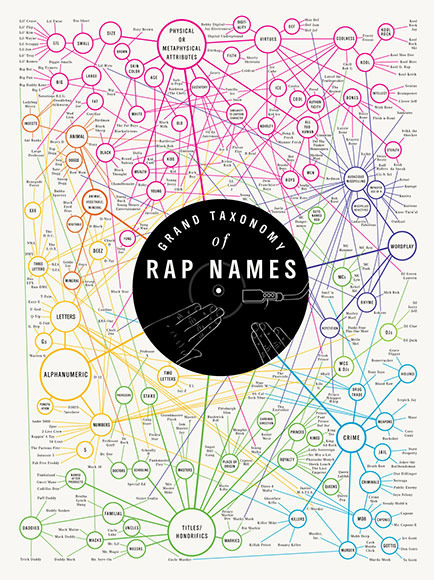
It all comes together in a wonderful way, and I think the names of people who gathered to play The Last Waltz would lead to some interesting intersections. Please add any musical lineages you can think of in the comments, and I’ll get cracking in Adobe Illustrator to make it look like a poster you would want to play loud.
My pop sent me a link of an interview with David Chang on The Paul Holdengräber Show. It’s worth watching if you’ve been to Momofuku, want to go (me), and/or you are interested in failure (everyone). Talking about life in general, Chang said, “Everything boils back down to risk.”
As a chef and as entrepreneur, Chang is accustomed to risk. Maybe more than most. He started with a “ridiculously small” noodle bar in the Lower East Side eight years ago, and now he is a cooking icon. It’s no big thing. As he says, “Who cares if you end in failure?”

Risk, failure and food have been on my mind after reading The Lean Startup by Eric Ries. The idea of taking a chance on what Ries calls a minimally viable product (MVP) is pretty well known in the food industry. You have got to get something on the plate, and there’s no need to fuss about how that gets done. In the same way, Ries advocates getting a product in front of customers fast and then seeing how they interact with it to help your execution improve. The opposite of this would be working out every bug and glitch in stealth mode until it was time to spring your device/site/service on the whole world. But what if they don’t like it?
One of Ries’ great examples is a startup that offers a web-based recipe search that can take the dinnertime hankerings you have and turn them into a complete, budgeted shopping list. One of the risks for this startup was that when they began the rollout to potential customers, they weren’t actually using their product. Instead of introducing a site that could handle a customer’s requests and spit out a list, they found one person who was open to the idea and went to her house and wrote down what foods she wanted to feed her family that week. Then they would consult chefs they had already lined up and determine what the ideal recipes and shopping list would be based on time-to-cook, cost, health and variety. They also made sure that all of the ingredients included in the recipes were at her go-to grocery store. And then they would collect a check from her for $9.95 a week! This doesn’t sound like a company that Google would swoop in and offer billions for in a few months.
The business partners were learning a lot though. Once they had perfected the system with one customer, they added another. Once they arrived at more than they could handle logistically, they started using their site and email to capture the information and deliver to the customer as promised.
The company, Food on the Table, started in Austin and is now in cities across the country. When you look at what they did, the beauty is in that there wasn’t much upfront risk. Or if there was, it was matched step-by-step by the amount of insight they were gaining. They flattened out expectations and gradually ramped them up based on what reality told them and what their missteps revealed – not on what they heard in a breathless meeting in a windowless room.
It sounds like that same experimental approach that has led Chang to his current level. As he says, “Let’s make some really big mistakes. They are exciting to me. Even bad mistakes. They’re not fun to deal with, but you learn. That’s life.”
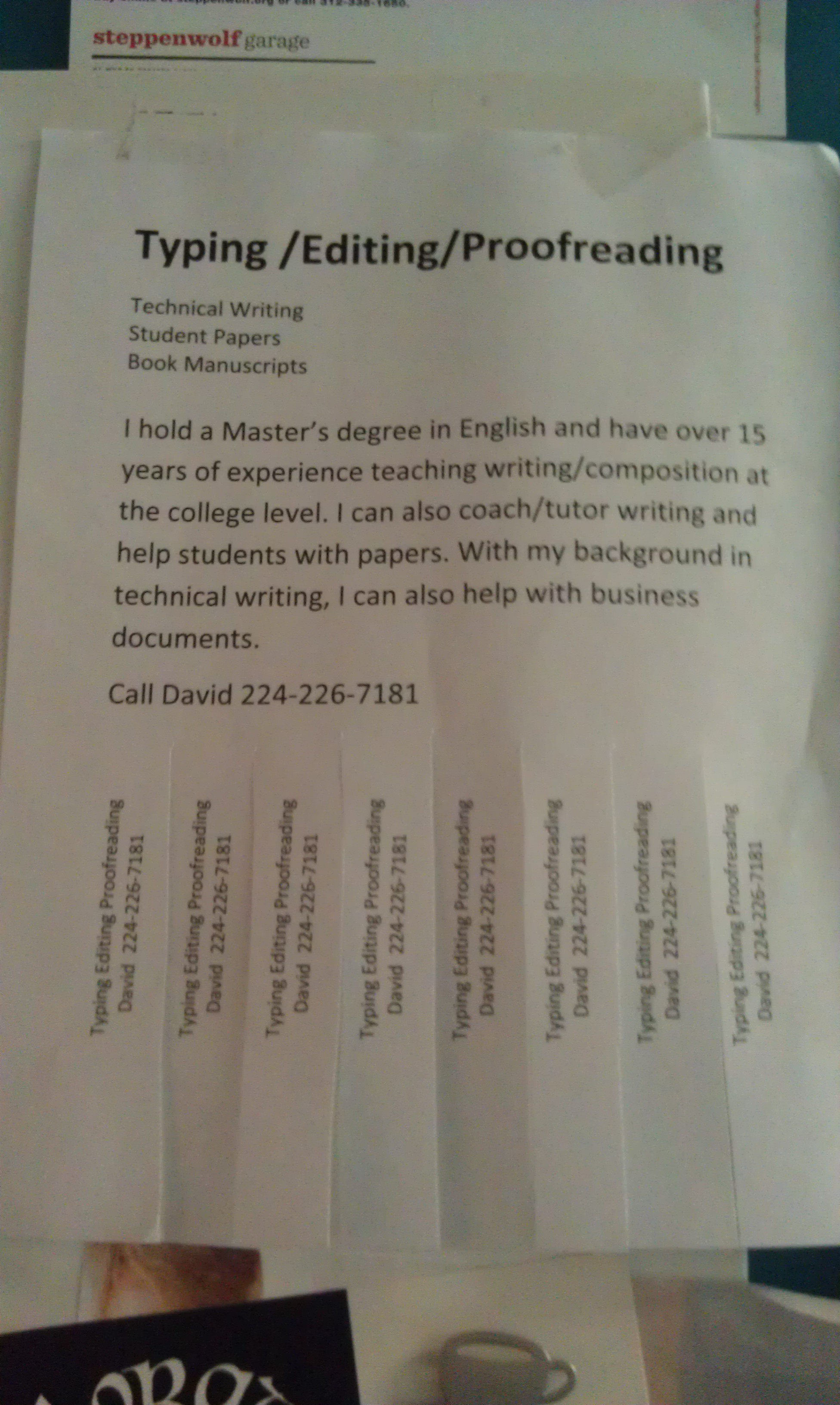
In the interest of helping out some Chicagoland writers and editors, I am passing on flyer information that I saw at a local coffee shop. Times are looking tight judging by the fact that no one has ripped the slips on these ads. Take a look and give them a call if you’re in the market!
As a side note, I think that the best spot for getting your content noticed might not be on a corkboard. This is the age of inbound marketing, and getting found is easier than ever. The best place to learn more about this is HubSpot’s blog.

The phone number is 847-869-6166.
Content creators, unite!
Like 100 million other people, I saw the Kony 2012 video over the past few days. It’s now considered the most viral video in history, per Mashable.

The merits of the Invisible Children video are clear, but the criticisms have been a little muddier. The ones I heard from established media outlets late last week were not outright nasty, but had an air of “Oh, really?” to them.
The need to sniff out what could be too-good-to-be-true (the 30 minute video is rather slick) puts journalists on other side of the story in a way that must be discomfiting. They have held IC’s founder Jason Russell to the same scrutiny, if not more, as they did Julian Assange. For Assange, a man who hides his judgment and tries to out objectify the news media, the message is that information will be liberated. For Russell, the message is that information will be used to accomplish specific goals. He is saying “I can shine a light on stories and injustices that are old news to you.”
The Times’ criticism turned out to be a common charge against the filmmaker:
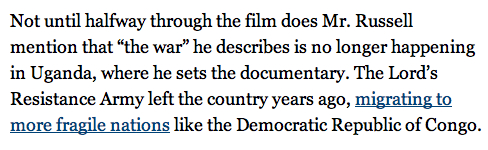
OK, but where does Russell set it up as a war to be stopped? It’s clear in the film that his goal is justice for what has occurred. Preventing attacks on civilians, conscription of children, and the sexual slavery of young women are acknowledged benefits of stopping Kony now, but the Times needs to point out that there is no war going on so why bother rubbernecking?
Last Friday, NPR’s Morning Edition engaged in a classic tactical maneuver when addressing the film: take the highest ground. They enlisted the head of the U.S. Africa Command (AFRICOM) to give an interview qualifying American interests on the continent. There was a smooth allusion to the 100 advisors sent to Uganda by the President to pursue Kony – but no mention of him by name.
They did mention him immediately afterward in the next piece, an interview of a Ugandan journalist. The echo chamber was deafening. The journalist made the point that the the Kony 2012 film wasn’t for a Ugandan audience. It wasn’t for people who knew the score. She then brought out the two tropes getting so much traction as criticisms of Invisible Children’s message: that the civil war is over and that Kony isn’t in Uganda. These are fine points for a journalist to make (game over; losing team left), but showed no insight into what the group was actually trying to accomplish.
The high ground had some other visitors in the form a blogger for Foreign Policy who has a more-of-the-same background on the region and narrow understanding of cause marketing and fund raising:

Money and awareness are probably what those well-meaning people can provide. But why would you need those when you have a nuanced understanding of the issue at hand? Let’s paraphrase for effect: “It would be great to get rid of cancer. It has left a wide path of destruction in our community for the past 20 years. But the type that people get now isn’t metastasizing and the tumors are very small. While it is still causing immense suffering, it’s unclear how emotional and financial support could help alleviate it.”
So this is the left flank of journalism in 2012. Fending off the aggregation monsters of Drudge, Huff and Buzzfeed has been best accomplished with the in-depth investigative journalism that commands attention for several days (or hours, if they’re lucky). This time the scoop was on an old story, a cold case. At 7 minutes and 30 seconds into the video you can see that Jason Russell makes promise to keep to his friend Jacob. He has a grudge. He doesn’t have a late night deadline to beat and an editor to impress. It’s a question of who can tell the most powerful story and he won. You can hear the reporters saying, “If we didn’t think it was a story now why is it a story now?” In fact, you can actually hear them say it in this Daily Show clip that made me think it was worth writing this post.
Not all hope is lost though. The Guardian gathers every angle together and talks to the only person we are made to truly care about in the film: Jacob Acaye.

My high school friend held in highest regard, Ballardvale and Boston’s own Tim Gould, a.k.a. @therealtbg12, sent the email below to me as a follow-up to the delivery of a Grateful Dead bootleg. It must be shared (the music and what he wrote about it) now that I have permission. The > symbols refers to transitions between songs. If anyone wants the bootleg, DM me @JamesonCase.

From Tim:
Help on the Way > Slipknot > Franklin’s Tower: August 13, 1975 at the Great American Music Hall, San Francisco, Ca.
PARADISE AWAITS! Truly one of the all-time great openings to any Dead album for me. Sick intro from the legendary Bill Graham while each band member kicks in his or her part of the song after their name is announced. The sound on that recording is magnificent and while Help > Slip brings the juice, it’s the Franklin’s that really pays off for me (“If you get confused listen to the music play…”). Jerry, Bobby and Phil all weave through the jam on top of some serious rhythm from the 8-armed, 2-headed Hydra that is Mickey Hart and Bill Kreutzman!
Small fact about said drumming monster: Early in their career when the band was young and living together in The Haight, Billy and Mickey would tie themselves together and play a single set of drums so as to create chemistry and truly understand what the other one was doing. I think it worked…
Scarlet Begonias > Fire on the Mountain: May 8, 1977 at Barton Hall, Cornell University
The greatest show in Grateful Dead history? I say YES! Not the lengthiest but certainly one that came during their peak of 1977 which in itself was arguably their best year. And this Scarlet > Fire is generally considered the baseline for all Scarlet > Fires! Phil’s opening bass riffs are sonically supreme and, I have to say, unlike any other version I have ever heard. Truly mesmerizing. Throw in Jerry’s transition from Scarlet to Fire and it’s 20 minutes of pure mind-melting joy.
I have had the privilege of going to Barton Hall and it’s pretty neat. An old school gymnasium that looks like an aircraft hangar. Big, huge arched ceiling, pull-out stands, basketball court flooring and tons of space for sounds to bounce all around in there. 5/8/77 must have been a truly magical night and if anyone ever wants the complete show, I have it and will pass it along. It’s a must own for anyone even remotely interested in the Grateful Dead.
St. Stephen > The Eleven > Turn on Your Lovelight at Fillmore West, 1969
I mean come on! A ridiculous full length Stephen (with original ending) into possibly the most underrated GD jam ever! I am huge Eleven fan. Its bizarre timing and 11 count is amazing and Jerry rips through this underplayed number with the utmost fury. Somehow the boys manage to find their way out of the late 60s haze into a Lovelight that has it all! Pigpen rapping away, Bobby singing his back-up portions enthusiastically and perfectly, and Jerry, along with Phil, tearing the roof of the Fillmore West with a perfect blend of blues-driven rock mixed with psychedelic lunacy!

I’ll post more soon – I know my three blog followers have been soooo distraught. My excuse: there’s no wifi on Highland Peak.

 The True Gen